Issues
Introduction
What is the tab? The Issues tab lets you track all issues of a project in one place. You decide which information to record and display, and you can share the list with people who don’t have access to the project by exporting it.
Who uses it?
Project managers and team members who register and maintain issues. Administrators/managers/support can also tailor the issue detail page layout.
What value does it deliver?
A single overview for issues with the columns you need, reusable filters/views, and the ability to export the list. You can also customize the issue detail page so the most relevant fields and segments are visible first.
What is the goal of the Issues tab?
The tab enables you to document all project issues and choose which information to store per project (for example, type, status, created date). Furthermore, the list of issues can be exported to a spreadsheet program or be printed, so it can be shared with people that don’t have access to the project.
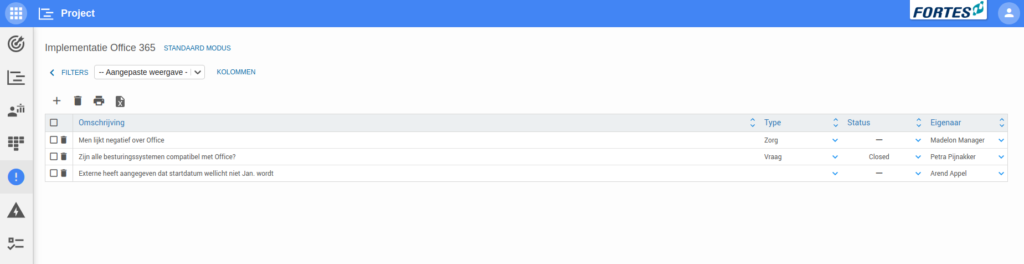
How to use the Issues tab
-
Decide which information you want to display and add it as columns (click COLUMNS and select the desired columns).
Examples:- Type shows the issue type (e.g., question or change request).
- Status shows whether the issue is solved.
- Owner lets you assign a person to the issue.
- Last edited on shows the most recent edit date.
-
Add an issue (click +), enter a description, and fill the remaining columns.
-
If needed, use a filter to show only the relevant issues. When you want to re-use filters, save a view.
-
Export the issues to a spreadsheet when you need to share them externally.
Customize the issue detail page (log item detail)
You can configure the detail page of log items (issues, risks, quality reviews, changes, learning points) to fit your needs.
- Open a log item’s detail page and use the menu button Adjust Page to enter the canvas configuration mode.
- This feature is available to administrator, manager, and support roles.
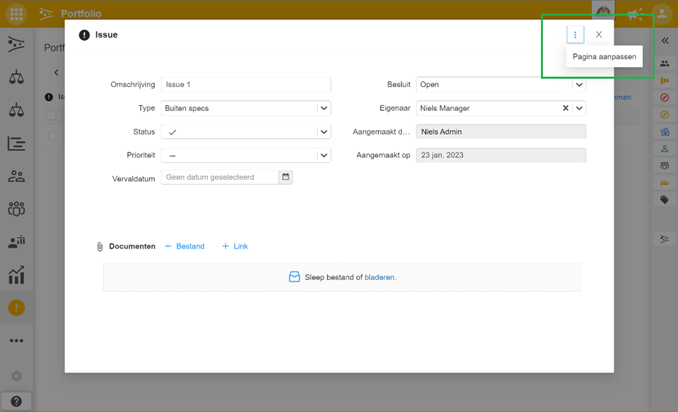
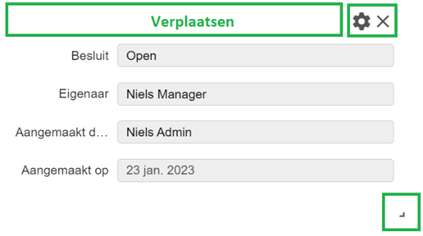
- Use the segment settings button to adjust a segment, the x to remove it, and + add segment at the bottom to add a new one.
- Reorder segments by dragging the header; resize with the corner handle.
- Click Reset to Default to restore the default layout.
Segment types you can add
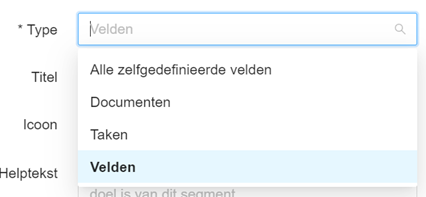
- Fields — select your own fields (this segment type can be added multiple times).
- All self-defined fields — shows all custom fields of the log item.
- Tasks — add tasks to the log item.
- Documents — add documents to the log item.
Where does a custom layout apply?
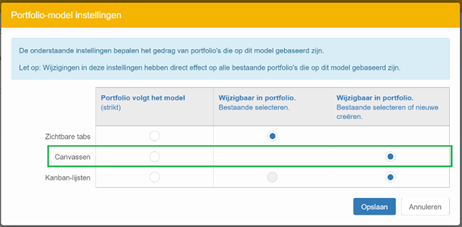
- You can set up a custom detail page per log item type in a project; that layout is available only in that project.
- To roll out custom detail pages across multiple or all projects, configure them in project models.
- In a model, you can choose to enforce the model strictly or allow projects to deviate from it.
Best practices
- Keep the column set lean; add only the fields your team actually uses.
- Save a view when you need the same filter/column setup again.
- Use export to spreadsheet to share with stakeholders who don’t have project access.
- On the detail page, put the most important segments at the top and use Reset to Default if the layout gets cluttered.
FAQ
Who can customize the issue detail page?
Users with administrator, manager, or support roles.
Can I add multiple “Fields” segments?
Yes. The Fields segment is the only segment type you can add more than once.
Do custom detail pages apply to all projects automatically?
No. A layout made in a project is available only in that project. Configure layouts in project models to roll them out more widely.
How do I share the issues with people outside the project?
Use Export to create a spreadsheet, or print the list.
Need more support?
Contact your Fortes Change Cloud administrator or consult the online knowledge base for more step-by-step configuration guides.
TODO: translate this document (user-docs/projects/issues.md).
Source: C:\Users\MilanOzinga\Development\fcc\knowledge-base\docs\user-docs\project\issues.md